I use this project to show how I approach research — the questions I ask, the tools I use, and how I make sense of what I find. One thing it doesn't include is customer interviews, which are the most important part of any client project. For that, the Laurel Leaf case study is a better picture of the full process.
It started with an off-hand comment from my husband. After a weekend trip to the garden centre, he remarked that houseplants were "an expensive hobby." He wasn't wrong. And it got me thinking.
I've been here before. When I was doing my PhD and money was tight, I had a greenhouse and a vegetable garden. I had no spare cash, but I spent a lot of time — and what little I had — cultivating plants.
This project started with that one question: why are we drawn to this "expensive hobby," especially when budgets are tight?
Houseplants are everywhere — in grocery stores, online stores, all over our feeds. I wanted to understand the real motivations behind the boom.
I'm using this project as a case study to walk through my four-step research framework. It's the same process — and the same tool, Dovetail — that I use for client work. I'll show how I tested learnings from Abi Awomosu's course, How to Use AI to Truly Understand Your Market, where AI helped, where it fell short, and how I'd move a project like this to a client-ready strategy.
Part 1: The discovery phase. What problem am I actually solving?
This is the most important step. Before you can get good answers, you have to ask the right questions.
The goal of the discovery phase is to define the problem and map out what I actually need to know.
Setting up the project
My initial curiosity was about the economic paradox. But as I outlined in my project plan, the research needed to investigate this dual nature: are houseplants a sign of affluence, or are they an accessible creative outlet for people with less control over their circumstances?
Based on that goal, I framed my initial research questions. I wasn't just after what people are buying; I was after the why.
- What are the primary reasons people buy houseplants and invest so deeply in them?
- What emotional trends are driving the interest?
- How do online communities and social media influencers shape the houseplant hobby?
- What does the trend say about modern values related to home, nature, and personal wellbeing?
- Are there specific nuances to this trend in Ireland?
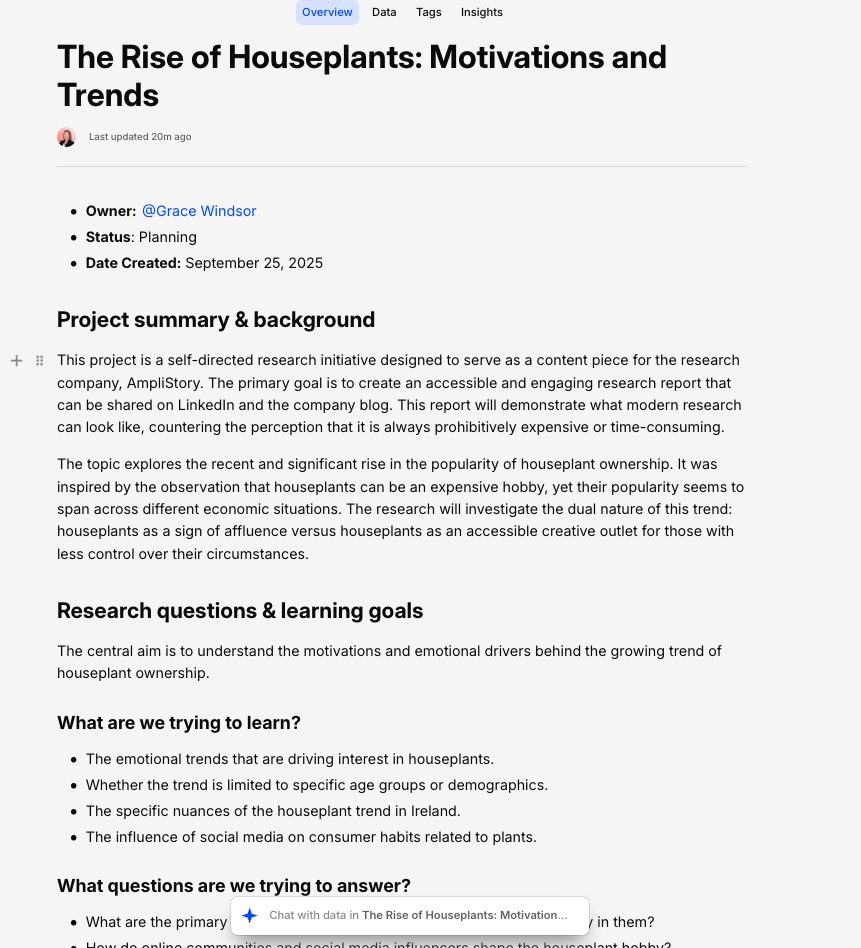
Project overview in Dovetail
You'll notice I didn't use AI at this stage. A common mistake is to throw AI at a problem immediately. At this point, the job was strategic thinking, defining the scope, and framing the questions. That's human-led work. The AI tools stayed on the shelf.
For the next phase, I would use a secondary desktop research methodology, systematically gathering and analysing publicly available data from online sources — Reddit, forums, and trend data — to see what themes emerge.
Part 2: The insights phase. Where does the data come from?
The "Insights" phase is where the data gathering begins. For a big, broad topic like this, the goal is to get a wide overview and then find specific, honest conversations.
My Research Toolkit
For this project, my toolkit consisted of:
- AI-Assisted Research: Google Gemini (as well as Perplexity and ChatGPT for comparison).
- Qualitative Social Listening: Deep-diving into Reddit forums using search tools like GigaBrain.
- Secondary Source Analysis: Reviewing the market reports, articles, and papers identified in the initial AI search.
- Research Repository: Tracking all data and emerging themes in Dovetail.
The Process in Action
The project started with a "deep research" prompt in Google Gemini. This is the most critical part of using AI—the quality of the output is a direct reflection of the quality of the prompt.
My prompt wasn't simple. It was a deeply considered set of parameters and guardrails. I didn't just ask "why are houseplants popular?" I asked the AI to act as a researcher and investigate the how and why of the surge, looking at specific spending patterns, cultural context, online community behaviour, and economic factors. I specified the need for market reports, consumer data, and geographic focus, with a clear instruction not to invent sources.
I ran this prompt across Gemini, Perplexity, and ChatGPT; the resources I got back from Gemini were significantly better. The AI's first job was to give me a synopsis of the market. Its real value, however, was in acting as a research accelerator. It effectively created a comprehensive bibliography for me, saving days of work.
But the AI overview, while a great starting point, lacked the texture of real, human conversation. This is why the second half of my insights process was purely human-led. I took my research questions to Reddit to find the unfiltered, spontaneous discussions that data summaries always miss. This is where the qualitative "why" behind the "what" started to emerge.
I tracked all of this—the articles, the forum threads, the quotes—in Dovetail, which set the stage for the analysis.
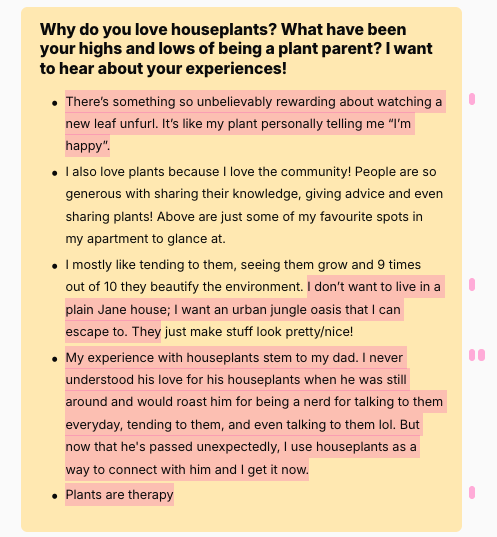
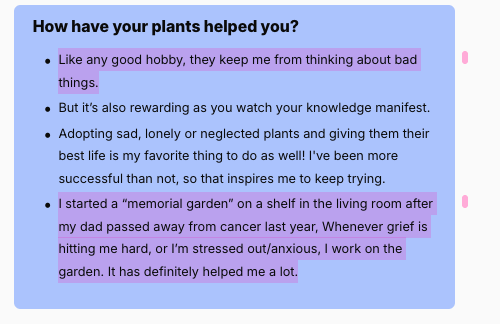
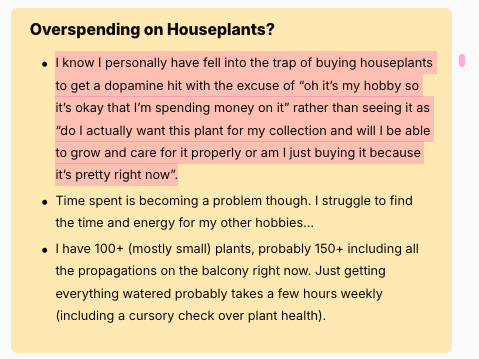
Examples of tagged Reddit quotes in Dovetail
Part 3: The analysis phase. What does it actually mean?
The goal of Analysis isn't just to report what I found. It's to connect the dots and find the "so what."
This is where I applied the techniques from How to Use AI to Truly Understand Your Market.
The core idea I wanted to explore is the difference between data mining and data foraging.
Data mining looks for patterns in massive, sterile datasets. It's what we often default to when conducting research. More is better, right? Data foraging is different. It's about digging into small, rich subsets of information to find the human drivers. The goal isn't just to see what people are saying, but to understand the subconscious instincts and emotional trends behind their words. Here, less is more.
We're looking for the human behind the action. And this applies just as much to B2B as it does to B2C. The person buying software on a Tuesday is the same person buying a houseplant on a Saturday. The same emotional drivers are at play.
My Analyst Tool
To go deeper, I used the frameworks from the course to build a custom GPT trained on specific methodologies. I didn't just ask it for answers. I built it to be a strategic partner — prompted to challenge my premises, spot my biases, ask clarifying questions, and help me select the right framework for the data. The goal was to use AI to go deeper, layer by layer, looking for unmet needs, buying journeys, and archetypal patterns. It's an iterative, human-led process. I pushed back, I prompted, I refined.
What the analysis uncovered
1. The "why" behind the buy: therapy, sanctuary, and identity
The analysis revealed that this multi-billion dollar trend isn't about decoration. It's a convergence of three powerful human drivers.
The therapeutic outlet: people are seeking tangible tools for mental health management. In a world of digital anxiety, the simple, grounding ritual of plant care provides a sense of purpose and a direct way to manage stress.
The domestic sanctuary: the pandemic-induced shift to a home-centric life was a critical inflection point. People were forced to re-evaluate their domestic spaces and began investing heavily in creating a sense of sanctuary. Plants were the most accessible way to do it.
The search for connection and identity: for a generation of millennials and Gen Z, the "plant parent" identity has become a powerful one. Nurturing plants often serves as an accessible precursor or substitute for traditional life milestones like homeownership or parenthood, filling a deep need for connection.
Explore the insight and quotes on Dovetail
2. The market we watered: from human need to a $30 billion economy
These three human drivers — therapy, sanctuary, and identity — created more than just a passing trend. They built a new, massive market from the ground up.
The scale of this shift is significant. This collective search for wellbeing has fuelled a global indoor plant market projected to approach USD $30 billion by 2029.
To see how profound this is, look at the data from Ireland: in 2020, consumer spending on gardening hit a record-breaking €1.2 billion. That's not just a surge — it's a structural shift, representing a 50% increase from 2018 and 14% higher than the previous peak during the Celtic Tiger economic boom.
But the most telling economic proof isn't a dollar amount; it's a behavioural one. Bord Bia's Value of the Garden Market 2020 reports that consumers clearly shifted their focus to plants rather than cut flowers — a fundamental change in consumer psychology. People were consciously choosing not to buy a passive, ephemeral decorative item. Instead, they were choosing an active, long-term investment and an ongoing project that demands nurturing, learning, and engagement.
Explore the insight and quotes on Dovetail
3. The new frontier: what this shift means for business
This maturation from a boom to a long-term hobby is where the real business insights lie. The market is no longer just about selling plants; it's about serving the dedicated hobbyist.
Three clear, forward-looking implications emerge from the analysis.
Solve plant parent fatigue: the hobby can become a chore. This creates a significant opportunity for businesses to create products and services that simplify care for large collections — smart planters, better apps, subscription-based care kits.
Build the digital toolkit: the trend is inexplicably linked to a digitally native demographic. Sophisticated plant care applications like Planta and Greg are becoming indispensable tools that build consumer confidence and democratise horticultural knowledge. This digital support ecosystem is a massive growth area.
Lead the sustainability demand: a major tension is the industry's own environmental footprint, specifically its reliance on plastics and peat moss. This creates significant opportunities for brands that can verifiably demonstrate sustainable practices. The future of the market will be defined by peat-free soil, recycled materials, and verifiable local sourcing.
Explore the insight and quotes on Dovetail
Part 4: How this translates to a client project
This case study was a solo sprint using desktop and AI-assisted research only. For a client project, the process is far more rigorous — and the most important difference is primary research.
In client work, I conduct one-to-one customer interviews: with buyers, users, and champions across the deal cycle. These conversations surface the language, triggers, and motivations that no amount of secondary research or AI synthesis can reliably find. They're also what makes the final framework defensible internally — when a CEO pushes back on a positioning decision, the answer isn't "we think this is right," it's "here's what twelve customers said."
The Laurel Leaf case study shows what that looks like in practice: twelve international interviews, Dovetail analysis, a full messaging framework, and a buyer's journey map — built on evidence rather than assumption.
Beyond interviews, a client project also includes:
- Internal data integration: existing website analytics, sales data, support tickets, and social data
- Stakeholder interviews: conversations with sales, customer success, and subject matter experts inside the business
- Quantitative validation: where needed, a survey to test qualitative themes at scale
The handover is also different. A solo research sprint ends with synthesis. A client project ends with a workshop — working through the findings together and turning them into a concrete set of next steps: new content pillars, a validated product idea, a campaign angle, a high-value partnership opportunity.
A 50-page report that sits in a drawer is useless. The goal is always insight that gets used.
Where AI genuinely helps — and where it doesn't
AI was an incredibly useful partner in this process. It is not a substitute for research.
It's a powerful accelerator. It picked up themes I could run with and saved me days of work. But if you're not careful, it can also lead you down the wrong path. The true skill is no longer just finding information, but interrogating the information the AI gives you.
Before writing my first deep prompt, I spent time reading so I knew what to ask. If you have a bias in your question, the AI will reflect that bias and take you down a very specific road. Even with the custom GPTs I spent time building and testing, I found consistent issues.
It flattens data. It has a tendency to misrepresent nuance or force information into an answer it thinks you want. It gets stuck. It can fall into logic loops or develop tunnel vision — if I queried one insight, it would often rewrite the entire output to align with that single query, losing the bigger picture. It hallucinates. It made up quotes, even when I provided it with real ones.
I still had to spend a significant amount of time verifying sources, questioning the analysis, and pushing back.
AI is a tool. It's not the strategist. You can't build a twelve-month business strategy on an AI report alone. You have to combine it with rigorous qualitative and internal methods. And you have to know your domain — or work with someone who does — so you can spot the biases and the flaws.
From "expensive hobby" to actionable strategy
The answer to the question my husband asked — why we invest in this "expensive hobby" even when money is tight — wasn't economic. It was about a deep human need for therapy, sanctuary, and identity.
An AI prompt didn't find that answer. A strategic, human-led process did.
This is the framework I apply to every client project. The tools change. The rigour doesn't.
Ready to put this into practice? Download my free Research Toolkit, which includes a checklist for applying insights.
Need a strategic partner to help you turn customer insights into a clear growth plan? Get in touch to book a 20-minute intro call.
FAQs
What research methods does this project use? This project uses secondary desktop research and AI-assisted analysis — specifically deep research prompts across Google Gemini, Perplexity, and ChatGPT, combined with qualitative social listening on Reddit. It does not include customer interviews, which are the primary research method used in client projects.
What is the difference between this project and a full client research project? The core difference is primary research. Client projects include one-to-one customer interviews — typically eight to twelve — alongside internal data review, stakeholder conversations, and a collaborative handover workshop. The houseplant project demonstrates the secondary research and analysis phases only. The Laurel Leaf case study shows what the full process looks like.
What is Dovetail and how is it used in research? Dovetail is a research repository and analysis tool. In this project, it was used to tag and organise insights from Reddit threads, articles, and forum conversations — keeping all data structured, searchable, and connected to its source. In client projects, it stores interview transcripts, tagged themes, and synthesised insights in a format the whole team can access after delivery.
What is the difference between data mining and data foraging? Data mining looks for patterns across large, often sterile datasets. Data foraging is about digging into small, rich subsets of information to find the human drivers behind behaviour. The goal of data foraging isn't to see what people are saying at scale — it's to understand the subconscious instincts and emotional triggers behind their words. For messaging and positioning work, data foraging is almost always more useful.
Where does AI help in research and where does it fall short? AI is most useful as a research accelerator — building a comprehensive bibliography, identifying themes to investigate, and saving time on initial market mapping. It falls short when it comes to nuance: it tends to flatten complex data, can develop tunnel vision when queried on a specific point, and will occasionally fabricate sources or quotes. It works best as a starting point that a skilled researcher interrogates, not a final output.
How does a research project end? For client projects, the process ends with a handover workshop — a collaborative session where findings are presented and turned into concrete next steps. This might mean identifying new content pillars, validating a product idea, finding a campaign angle, or prioritising a feature roadmap. A report alone is not the deliverable. Insight that gets used is.
What kinds of businesses is this process suited to? The process is suited to B2B companies where messaging clarity is a growth bottleneck — typically businesses planning a rebrand or new website, launching a new product or entering a new market, or dealing with misalignment between sales, marketing, and product. The research framework scales from a focused messaging sprint to a full strategic deep dive depending on the complexity of the challenge.